LA WEEKLY
It’s here, it’s finally here (no, not the Man With the Child in His Eyes) but an archive of L.A.’s influential publication, the LA Weekly — easily discerned by the title.
To be fair, that opener is a bit misleading, because what is on offer is woefully short of complete, due to the difficulty of acquiring forty-five years’ worth of a weekly publication.
Fortunately, this handsomely-mounted archive contains a lovely number of early issues; 1978 through 2000 (I have issues beyond that year, but they weren’t included). Aside from the covers, the interior pages were also given attention — film, music, memorable columns, and various articles.
The LA Weekly might not have happened if born-again Larry Flynt had gotten his way. The head honcho of Hustler magazine had purchased the troubled LA Free Press in late 1977 and assigned Jay Levin as its new publisher. In January 1978, Levin's goal for the Free Press was to turn the publication "into a hard-hitting investigative newspaper." First item to go would be the maligned classifieds.
Less than two months into the job, Levin was fired. In March of 1978, Larry Flynt, the founder of Hustler magazine, survived an assassination attempt, rendering him unable to deal with business matters. The Free Press went limp.
Jay Levin
A Los Angeles native and UCLA graduate, Jay Levin earned a master's degree in journalism from UC Berkeley (where he wrote for the Berkeley Barb). The former New York Post reporter sensed a void in the alternative weekly space and regrouped with an investment group of backers, including actor and producer Michael Douglas, video entrepreneur Joe Benadon (1938-2010), film producer Burt Kleiner, and Track Records founder Pete Kameron (1921-2008).
In the Beginning
After assembling a small team — including Ginger Varney, Michael Ventura, and Josephine (Joie) Davidow — plus a reported $300,000 to get the ball rolling, the LA Weekly ("a cross between High Times and Newsweek") was born.
Regarding the editorial content, Levin said in 1978, “It’ll be based on a mixture of journalism and cultural arts, anchored by a thick entertainment guide.”

The LA Weekly’s first office at 5325 Sunset Blvd. was a “trashed old two-story house in a Hollywood war zone a couple of blocks from the Pussycat Theatre.” — and demolished in 2001.
Sunset Boulevard, 1973 : Roll 1 : Western Ave headed east : Image 38. photo by Edward Ruscha.

From 1994 until 2008. The LA Weekly’s office was in the former home of the Sunset House retail store/Hollywood Reporter office.
Despite early losses, with revenue coming entirely from ad space, the LA Weekly was profitable by 1982 — up from 24 pages in 1978 to 112 pages. Along the way, the Weekly picked up accolades from the California Newspaper Publishers Association — for a smog series in 1980 and a Los Angeles Press Club award for “best weekly newspaper” in 1982.

The early days counted several notable writers, including Stuart Goldman, Michael Ventura, and James “BigBoy” Medlin — the latter two collaborating on the 1980 movie Roadie. The Texas-born Medlin was a founding writer of the weekly newspaper, The Austin Sun, along with Ventura, Ginger Varney, and Bill Bentley. After moving to Los Angeles in the late 1970s, the group helped found the LA Weekly.
L.A. Reader

However, LA Weekly had competition. The L.A. Reader — an offshoot of Chicago’s successful weekly, also came of age in 1978. Published by Robert Roth, the Reader was edited by Chicago staffer Jane Levine. The position was later held by James Vowell (d. 2019), formerly editor of the Pasadena Weekly.
In 1989, while looking to maintain its earlier momentum, the Reader was sold to a newly-formed group led by Vowell and published under a license agreement with the Chicago Reader. Other changes included a change to the logo and reducing the format size.


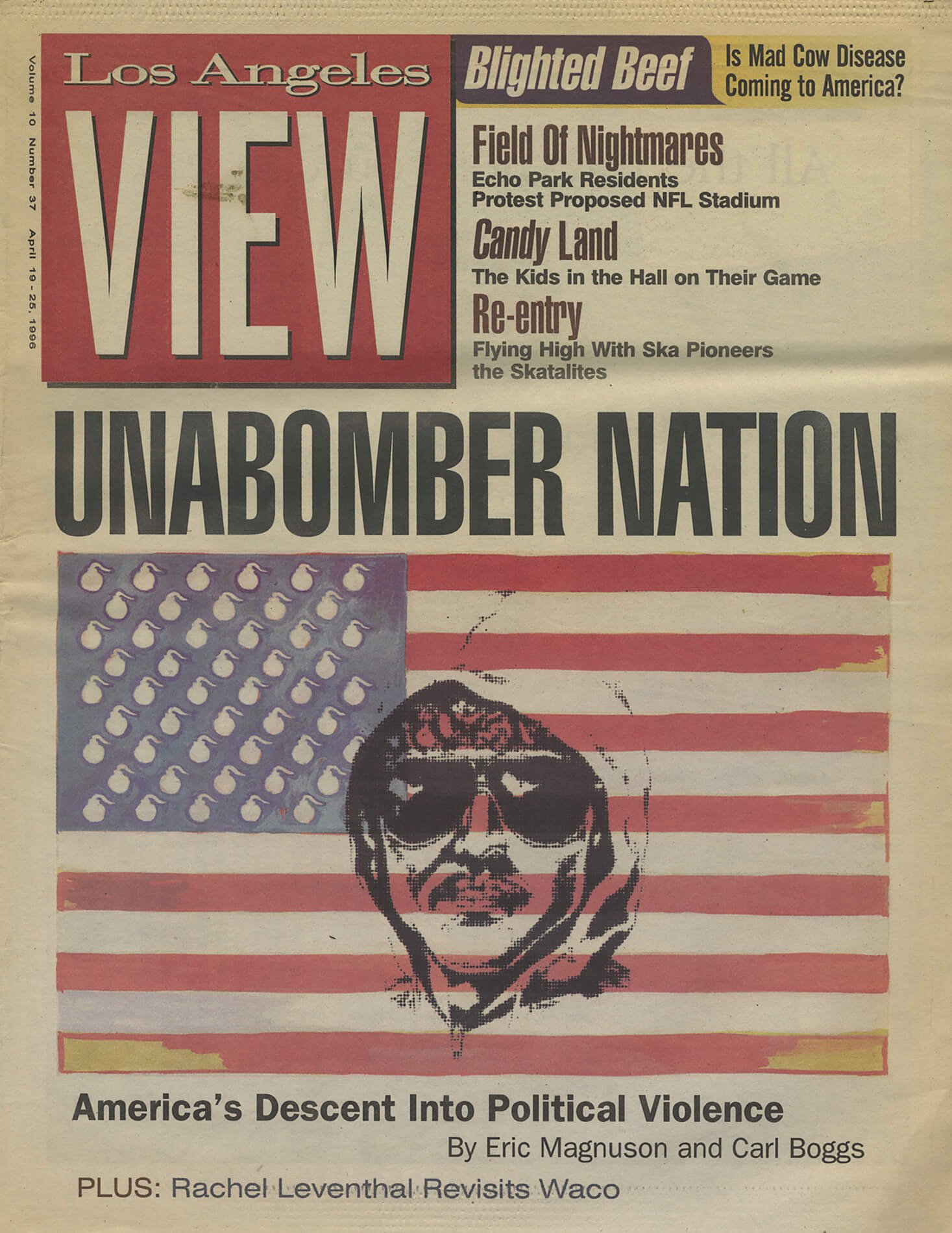


Edited by R. E. Maxson.
Edited by Ian Brodie and Melani Davies.

Ad from Steve Samiof’s STUFF magazine, 1984.
One of the LA Reader’s memorable columns was “Take My Picture, Gary Leonard,” later featured in New Times, City Beat, and LA Observed.
Among the staff members was cartoonist Matt Groening, first hired to write stories and later hired as circulation manager in 1979. A year later, the Reader published Groening’s “Life in Hell” strip, which departed for the LA Weekly in 1986.


At the tailend of 1983, the LA Weekly moved to new digs in Silverlake. The former office is currently home to an architectural firm.
The Weekly made its push into the Valley in October 1983, where the LA Reader already had a presence.
We want the Weekly to become a household word in the Valley, as it is on the other side of the hill. It is not yet something people are sure to pick up so they know what to do for the weekend.

- Marci Marks (distribution Manager), 1984.
The separate customized edition for the San Fernando Valley carried over many features, but also offered lower advertising rates for Valley businesses.
By 1985, the LA Reader was faltering and soon purchased by the New Times (also responsible for shuttering the LA View). But in the aftermath of some messy corporate capers, rose CityBeat — a free downtown weekly.
Back at the LA Weekly, the paper was doing so well, Jay Levin started another title called
LA Style. The fashion-forward publication was sold to American Express Publishing in 1988.
Levin would later step down as publisher when former Record World editor and Long Island native Michael Sigman took the reins in 1983. Six years later, Sigman left "for other independent features” and was replaced by board member Gary Horowitz, though his tenure was short-lived.
Sigman returned to the fold in 1990, only to depart for Phoenix-based Village Voice Media in 2000 (the company would acquire both the LA Weekly and OC Weekly).
By the mid-1990s, the Weekly had unionized, replaced Kit Rachlis with former USC journalism major Sue Horton as editor, and moved its office to Sunset Blvd.

Despite the changes, the LA Weekly was named “best alternative newsweekly” by the Utne Reader in 1999 and received accolades from the Association of Alternative Newsweeklies (AAN), and finalists for the PEN West literary journalism awards between 1996 and 2001.
However, by the time of the Weekly’s 20th anniversary in 1998 — when circulation was around 220,000 — more staff changes were on the horizon; Michael Sigman, Judy Jablonski, and editor Sue Horton would later exit.
Speaking on her departure in August 2000, Sue Horton commented, "I love this paper, and it's really wrenching to leave. But 6 ½ years is a long time to do this job." Under her direction, LA Weekly president Michael Sigman said the paper is "the best it's ever been."
Within months, Laurie Ochoa — former LA Weekly intern and executive editor at Gourmet magazine — took over as editor. She would remain with the LA Weekly until 2009, amid a mass exodus of fellow staffers.
Then-owners, Voice Media Group unloaded the Weekly to new ownership in 2017, inflicting significant damage, with longtime staffers getting their walking papers. After some intrigue, the identity of the new owners came to light; Orange County-based Semanal Media. The growing company enlisted former Orange County Register op editor Brian Calle as manager.
Calle told the Los Angeles Times, “LA Weekly has the ability to be the cultural center of the community.” In 2017, Calle was one of the owners who fired all five of the publication’s editors and all but one staff writer.
The LA Weekly without its liberal, anti-establishment politics, is like 'Hamlet' without the price.- Harold Meyerson, Los Angeles Times, December 24, 2017.
Today, the LA Weekly has the substance of a hastily-written sign for a lost cat, and it is a far cry from the formidable force it was.

All the good stuff… music, film, and various bits and bobs.